
If you’re shipping a vehicle, heavy machinery or other oversized cargo overseas – or importing it to the U.S. – roll-on/roll-off shipping (RoRo shipping) can be one of the most efficient ways to move it from origin to destination. Because cargo is driven or rolled directly onto and off the vessel, RoRo vessels can simplify handling, reduce the need for cranes, and minimize handling-related damage. Depending on the cargo and route, it can also be more cost effective than container shipping.
What is involved in RoRo shipping, and when does it make sense? What are the main domestic and European ports that handle RoRo vessels? We’ll explain that and more in this article.
What Is RoRo Shipping?
 RoRo shipping is a method of transporting vehicles and machinery aboard specialized vessels using built-in ramps. It is commonly used for wheeled cargo such as cars, trucks, heavy machinery, construction equipment, and other vehicles that can be driven or otherwise moved onto the vessel.
Roll-on/roll-off vessels can also accommodate oversized cargo that is not self-propelled or mounted on wheels. In these cases, cargo can be loaded onto one or more MAFI trailers – large, wheeled platforms designed to move heavy or oversized freight. Crated cargo, boats, machinery and other bulky equipment can be placed on the trailers by crane or forklift and then towed aboard the RoRo vessel.
Because cargo is driven or towed directly onto and off the vessel, RoRo shipping can reduce the number of times suitable cargo needs to be lifted or transferred compared with containerized shipping. But that does not necessarily make RoRo terminal handling faster or less expensive. RoRo shipping terminals are more specialized and typically process fewer shipments than container terminals, while oversized or heavy cargo may require cranes, forklifts, MAFI trailers, or other specialized equipment.
Handling charges, therefore, vary considerably by port, cargo size, weight and equipment requirements. In some cases, RoRo shipments can also involve longer terminal dwell times or waiting for available handling capacity. Depending on the cargo, route and terminal costs, however, RoRo can still be a cost-effective alternative to container shipping.
How Much Does RoRo Shipping Cost?
The economics of RoRo shipping become more compelling as cargo moves beyond the practical limits of standard containerization. But there is no single weight, length or footprint at which RoRo shipping automatically becomes the cheaper option. The better comparison is the total cost of moving the cargo, including ocean freight, port handling, inland transportation, warehouse labor, and any specialized equipment required.
For large or heavy cargo, containerization can introduce additional costs. Oversized cargo may require a flat rack rather than a standard container, specialized trucking to the port, additional loading or securing work, and higher out-of-gauge charges from the ocean carrier. If the cargo cannot move efficiently through the rail intermodal network, the cost advantage of container shipping can diminish further.
Roll-on/roll-off shipping has its own cost considerations. Andrew Rozek, president of New Jersey-based NVOCC I.C.E. Transport, said RoRo terminal handling is more specialized and requires additional labor or equipment.
“With RoRo, there are obviously port handling charges involved, and they go up for an oversized shipment,” Rozek said. “They’re based on volume and weight, just like ocean freight. Factors affecting the handling cost include whether it needs an overhead crane, whether it can be forklifted, or any other types of special requirements.”
RoRo terminals generally handle fewer shipments per day than large container terminals, and oversized cargo can require more time and manpower to process. That means RoRo handling charges can be higher, and terminal congestion or waiting time can add to the cost. Charges also vary significantly by port.
To determine the most economical mode for large, heavy equipment, you must consider all costs incurred during the entire shipment journey, not just the ocean rate. A piece of machinery that is expensive and complicated to containerize may still be cheaper to move via a RoRo vessel even if the RoRo terminal handling charge is higher. Conversely, cargo that fits efficiently into a standard container and can move through an established drayage and rail network may remain more economical as containerized freight.
Port selection can also change the equation. Rozek points to Baltimore as an example. Baltimore has long been a major RoRo shipping gateway, particularly for automobiles, and its specialized RoRo infrastructure can make its handling costs attractive compared with other ports. He notes that this can matter even when the inland trucking distance is slightly greater.
“Depending on where you're going, whether it’s Southeastern Pennsylvania, South Jersey, or west into Illinois or Ohio, you may save enough on the port charges to go out of Baltimore, even if the trucking may be a few dollars more,” Rozek said. An experienced RoRo shipping company like I.C.E. Transport can crunch the numbers and tell you the most economical mode.
While most major container lines no longer call on Baltimore for economic reasons, RoRo specialist ocean carrier ACL has regular sailings between there and Hamburg, Antwerp and Liverpool.
The broader lesson is that RoRo shipping economics are about more than finding the lowest ocean rate. Shippers should compare the total landed cost of ocean freight, terminal handling, warehouse labor (if applicable), and inland transportation, plus potential waiting time for each option. As cargo becomes larger, heavier or more difficult to containerize, those additional costs can make RoRo increasingly attractive.
RoRo Shipping Ports, Domestic and European
When importing heavy machinery, construction equipment or vehicles from Europe to the U.S., you need to consider that there are fewer ports set up to handle the logistics of RoRo shipping. On the East Coast, the major ports for RoRo are New York/New Jersey, Baltimore, Norfolk, Va., Brunswick, Ga., New Orleans, and Houston/Galveston, Texas.
A company moving a container often can choose among several nearby gateways, while a shipper using RoRo may have to route inland to a more distant specialized gateway. This is a particularly important consideration when comparing RoRo transport with container shipping for heavy equipment.
Suppose a piece of machinery is located near a port with abundant container service but no suitable RoRo service. You can’t assume RoRo is the cheaper or easier choice because the equipment itself is well suited to RoRo. It may have to go by truck to a specialized RoRo gateway, instead of a closer container port. That additional inland leg can change the economics considerably.
This works in reverse, too. An importer might have excellent RoRo service to Baltimore or Brunswick, but if the final destination is far inland, the transportation cost after discharge can erode the advantage.
For exporting from the U.S. to Europe, the main RoRo ports are as follows:
Northern Europe
-
Zeebrugge, Belgium — part of the Port of Antwerp-Bruges, handling 3.34 million new cars in 2025, making the combined port the world's largest automotive port.
-
Antwerp, Belgium — a major RoRo and overweight/OOG cargo gateway, with extensive deep-sea connections.
-
Bremerhaven, Germany — one of Europe's largest RoRo ports for the auto industry and an especially important gateway for German vehicle exports and OOG cargo.
-
Emden, Germany — a major automotive RoRo port.
-
Rotterdam, Netherlands — a major RoRo hub, particularly for short-sea trailers, vehicles and project cargo.
-
Vlissingen, Netherlands — a significant automotive and RoRo port.
The UK
-
Southampton — one of Europe's major vehicle RoRo ports and the UK's principal automotive gateway.
-
Liverpool — important for transatlantic RoRo and project cargo.
-
Immingham/Humber — handles significant RoRo and vehicle traffic.
-
Transit Times Between Europe and the East Coast Via RoRo
-
For roll-on/roll-off shipping, here are transit times between East Coast ports and Hamburg, as an example, based on ACL’s schedule and other sources (as of Sept. 3, 2026):
|
Hamburg to U.S. East Coast Ports |
||
|
Destination |
Approximate Time |
Notes |
|
New York/New Jersey |
16-17 days |
Times vary |
|
Baltimore |
18 days |
ACL published RoRo service |
|
Norfolk |
20 days |
ACL published RoRo service |
|
Brunswick |
25-30 days |
Service-dependent; typically requires a different RoRo service/rotation than the North Atlantic ACL route. |
|
New Orleans |
30-32 days |
Ocean routing is substantially longer; current container routing data shows ~31.5 days for the quickest service. |
|
Houston/Galveston |
24-30 days |
Houston container service can be 24–25 days, but RoRo availability and routing can differ substantially. |
And here are transit times from select East Coast ports to Hamburg via RoRo vessels. For Brunswick, New Orleans, and Houston/Galveston, there are no published ACL RoRo transit times as they are service dependent.
|
U.S East Coast Ports to Hamburg via RoRo |
||
|
U.S. Port |
RoRo Transit to Hamburg |
Notes |
|
New York/New Jersey |
17 days |
ACL RoRo |
|
Baltimore |
14 days |
ACL RoRo |
|
Norfolk |
13 days |
ACL RoRo |
RoRo Shipping vs. Flat Rack Containers
Using a MAFI trailer can sometimes be more cost effective than moving the same oversized cargo on a flat rack aboard a container ship. The economics depend heavily on how the carrier prices OOG cargo.
Container carriers often position OOG cargo on the top deck so it does not take up a standard container slot. However, the carrier's OOG pricing may account for the cargo's potential to limit how containers can be stacked around or above the flat rack. In those cases, the MAFI option on a RoRo vessel may offer a lower overall cost.
The best option ultimately depends on the carrier, trade lane, cargo dimensions and weight, terminal charges, and the specific pricing available for the shipment. A flat rack may be more competitive on one route, while a MAFI trailer and RoRo service may make more sense on another.
Rozek said there are other considerations when weighing RoRo vs a flat rack container. “The floor in a flat rack is thicker than a standard container because it has to compensate for the lack of structure, meaning no walls and roof,” Rozek said. “You will find that the floor of a flat rack is a foot and a half thicker than a standard container. All of a sudden, it's adding that extra height to your cargo, which may now run afoul of height limits for the ocean line as well as over-the-road trucking, even if you use the lowest possible chassis.”
Inland Transportation and the RoRo vs. Container Decision
The inland transport leg also influences the RoRo vs. container decision. Oversized cargo that cannot move by rail loses one of the major cost advantages of container shipping and generally requires specialized trucking. In some cases, the cargo must first be trucked to a port area warehouse, unloaded from a flat rack, and then transferred to a specialized trailer.
When those trucking, warehouse and handling costs are added together, shipping the cargo RoRo — potentially using a MAFI trailer — can become the more economical option. The tradeoff is that specialized oversized trucking has fewer carrier options and can cost more than standard container drayage.
“You really don't want to be trucking a container long distances because of the cost,” Rozek said. “It’s a more specialized area. Both here and in Europe or anywhere else, there are fewer truckers able or willing to handle oversized cargo.”
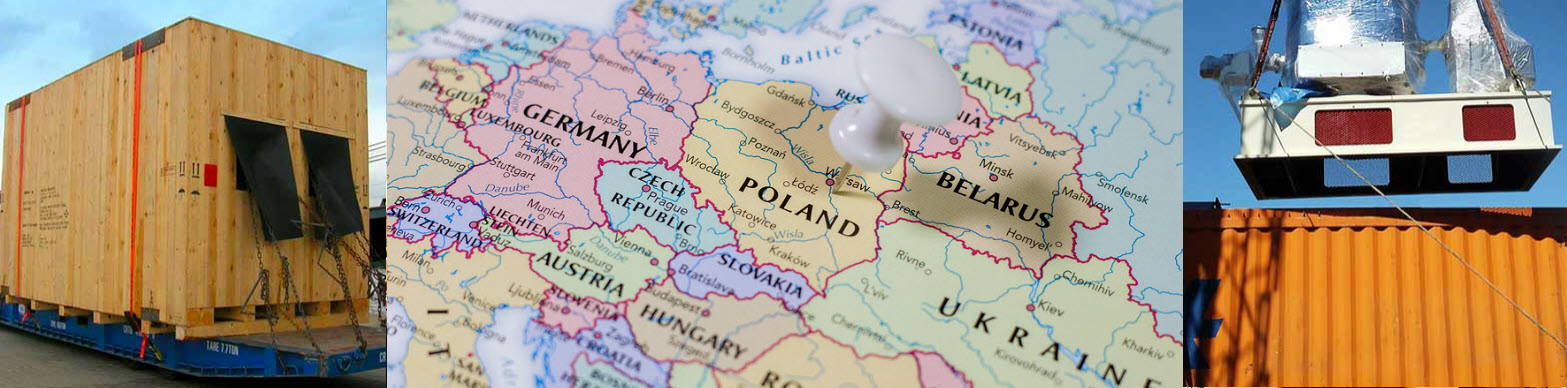
In particular, importing this kind of cargo into Poland from the U.S. calls for more complex logistics, as there isn’t direct RoRo service from the East Coast to Polish ports like Gdansk and Gdynia. One option is going via flat rack container to a North Sea port like Bremerhaven or Hamburg, followed by transshipment via a feeder vessel to Poland. Another option is to ship via RoRo to one of those ports and then go via specialized truck to Poland.
Benefits of a U.S.-to-Europe RoRo Shipping Company
There are many moving pieces to examine when deciding to ship via flat rack container or a RoRo vessel. You need to look at the inland transport costs, transit times, available sailings, plus any special handling that could be involved. For smaller companies, the time and resources required to do a proper analysis are just not available. In such cases, a freight forwarder experienced in RoRo shipping via can provide expert input to help you make the right choice.
If you are looking for a RoRo shipping company, I.C.E. Transport has nearly 40 years of experience shipping machinery, construction equipment and other oversized cargo safely and economically. We can help you consider every angle to make a choice that aligns best with your business needs and budget. Contact the RoRo shipping experts at I.C.E. today.